Lijah Light
Industrial White Paper: CE Certified LED Emergency Lighting Technologies
In municipal planning, commercial real estate development, and heavy industrial facilities, emergency lighting systems serve as the core architecture for life safety. When power outages, natural disasters, or structural fires occur, the continuous and uninterrupted supply of illumination prevents panic and guides building occupants along designated escape routes. Ensuring these emergency systems conform to the highest safety guidelines is paramount. Guangdong Lijah Light Co., Ltd. stands as a key partner for global distributors and project specifiers, providing reliable and CE-certified LED emergency luminaires engineered to excel under extreme conditions.
1. Global Compliance Framework & CE Certification Standards
CE Certification for LED emergency lighting is not merely a label; it represents rigorous adherence to European directives designed to protect human life and structural integrity. A compliant LED emergency lighting fixture must fulfill multiple interdependent regulatory standards:
- EN 60598-2-22: The primary safety standard outlining specific design requirements, mechanical robustness, thermal pathways, and battery management parameters for emergency luminaires connected to backup power systems.
- EN 60598-1: General requirements and tests for electrical safety and insulation.
- EN 62471: Photobiological safety testing to guarantee that high-intensity LED chips do not emit harmful optical radiation to human eyes.
- EN 55015 & EN 61547: Electromagnetic Compatibility (EMC) regulations, verifying the system neither interferes with other communication hardware nor is vulnerable to external electromagnetic surges.
Expert Note: In addition to CE compliance, Lijah Light’s manufacturing pipeline processes key materials to secure approvals across diverse regions. Our product series integrates certifications including TÜV, ENEC, VDE, SAA, C-Tick, CB, LM79, and LM80, establishing a robust compliance framework for international developers.
2. Localized Application Scenarios & Engineering Requirements
Emergency lighting cannot be deployed with a "one-size-fits-all" mentality. Different architectural layouts and site conditions demand targeted engineering considerations:
Deep Underground Parking & Transit Systems
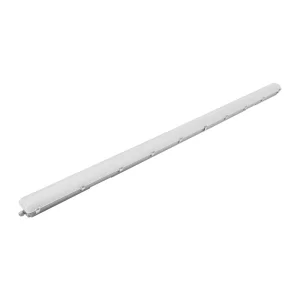
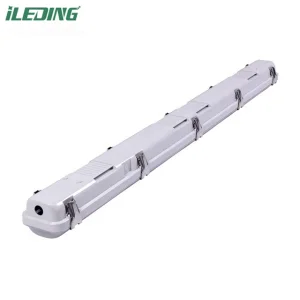
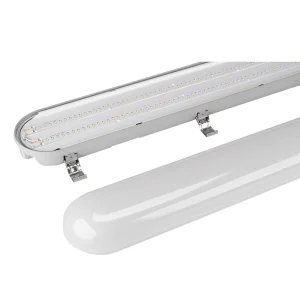
Subterranean spaces are prone to high humidity, vehicular emissions, and condensation. Emergency lights must feature minimum IP65 or IP66 vapor-tight sealing. Our IP66 Waterproof Vapor Tight Luminaires protect sensitive emergency circuitry and high-capacity battery packs against water ingress and corrosive atmospheric elements, ensuring reliable operation when municipal grid power fails.
High-Risk Industrial & Petrochemical Plants
Industrial processing spaces present harsh environments with chemical vapors, dust, and potential mechanical vibration. Luminaires here require robust housings (die-cast aluminum or heavy-duty polycarbonate) and IK08 to IK10 impact ratings to prevent damage from moving equipment. The integration of high-lumen outputs ensures that workers facing high-risk processes have sufficient time to execute shutdown procedures safely.
Commercial Office Precincts & Public Spaces
Architects prioritizing aesthetic harmony require low-profile, high-efficiency fixtures. The design criteria here focuses on the anti-panic open area requirements (minimum 0.5 lux at floor level) and escape route lighting (minimum 1.0 lux along the center line). Utilizing DIALux simulations, Guangdong Lijah Light assists developers in modeling photometrical profiles to ensure correct lux distribution with minimal fixtures, reducing overall capital expenditures.
Detention Facilities & Psychiatric Institutions
Vandal-resistant fixtures are critical in high-security public sectors. Here, LED emergency fixtures must feature tamper-proof screws, impact-resistant polycarbonate diffusers, and flush-mounting to prevent weaponization or access to the internal components. Our specialized vandal-resistant prison tri-proof lights meet these challenging parameters while integrating dual-purpose normal and emergency backup drivers.
3. Product Performance & Selection Framework
| Parameter / Feature | Industrial Grade (Vapor Tight / Tri-proof) | Commercial Emergency Lighting | Architectural & Pathway Lights |
|---|---|---|---|
| IP & IK Ratings | IP65/IP66 Waterproof, IK08-IK10 | IP40/IP54 Dustproof, IK07 | IP66 Waterproof, IK08 |
| Emergency Duration | 90 to 180 Minutes (Configurable) | 90 to 120 Minutes | Up to 120 Minutes |
| Battery Chemistry | LiFePO4 (Lithium Iron Phosphate) | NiMH / LiFePO4 | NiCd / LiFePO4 |
| Operational Temp. | -20°C to +50°C | 0°C to +40°C | -25°C to +45°C |
| Testing Systems | Self-Test / DALI-2 Central System | Manual Push / Self-Test | Self-Test Interface |