Why Choose UFO High Bays Over Linear High Bays?

Time:2026-10-26 Author:Sienna
0%

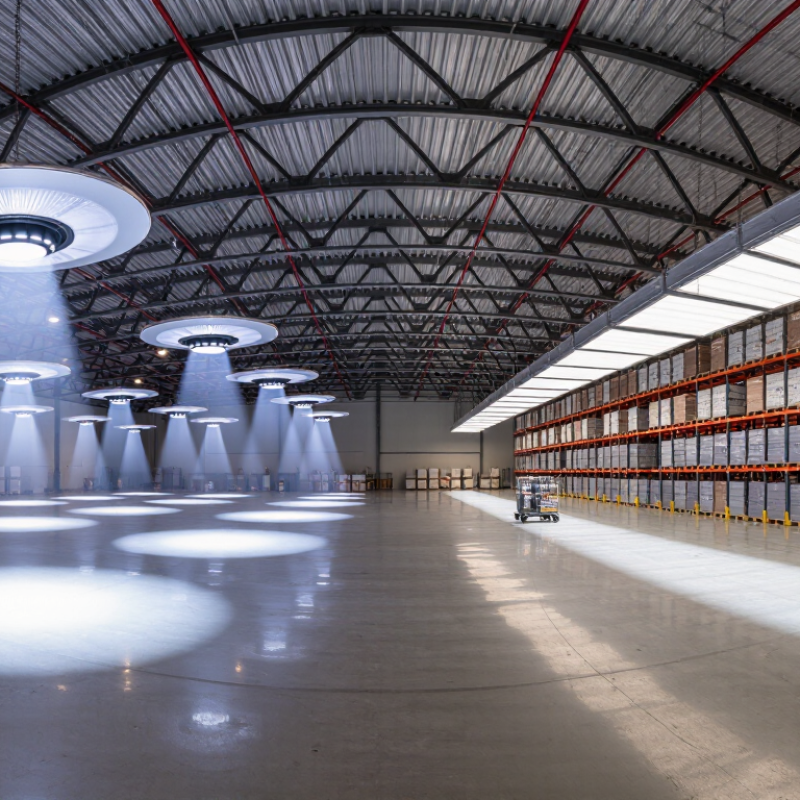
Choosing the right high-bay fixture affects visibility, energy use, maintenance, and worker comfort. The question “why choose ufo high bays over linear high bays” deserves a practical answer, not a sales slogan. UFO high bays use a compact round housing, often with a wide beam pattern and efficient LED modules. Their shape can distribute light evenly across open floor areas. This works well in warehouses, workshops, gyms, and manufacturing spaces with ceilings around 20 to 40 feet high.

Installation can also be simpler. A UFO fixture usually hangs from a hook, chain, or pendant, leaving fewer long parts above busy work zones. Its sealed housing may reduce dust and moisture concerns when the product has a suitable IP rating. However, performance depends on the actual model. Check the lumen output, beam angle, color temperature, glare control, and thermal design. A bright fixture is not automatically a better fixture.

Linear high bays still have clear strengths. Their rectangular form can follow aisles and shelving, creating focused rows of light with fewer dark gaps. In a narrow warehouse, that layout may outperform a round fixture. I have seen projects favor UFO high bays for open ceilings, then reconsider after a lighting simulation revealed aisle shadows. That decision was not wrong, but it was incomplete. Reliable selection requires photometric files, mounting dimensions, controls, warranty terms, and verified safety certifications. A qualified lighting professional should also confirm local electrical and building requirements. The best choice depends on the room, not the fixture’s popularity.
Why Choose UFO High Bays Over Linear High Bays?

UFO and Linear High Bays: Definitions, Form Factors, and Beam Patterns

UFO and linear high bays are not simply two shapes of the same fixture. A UFO high bay has a round housing, usually with a central LED array and heat sink. Its compact form spreads light in a circular pattern. A linear high bay uses a long, rectangular body with LED boards arranged along its length. The body resembles a suspended strip.

Beam pattern changes the entire lighting plan. UFO fixtures commonly use wide beams, often between 90 and 120 degrees. They can illuminate open warehouse floors, loading areas, and manufacturing spaces from high ceilings. Light falls outward like a cone. Linear fixtures usually create a longer, more directional distribution. They work well above aisles, where shelving runs in straight lines. Their shape can support cleaner row-to-row uniformity.

In a 25-foot warehouse, I would check rack height, mounting spacing, and glare before choosing. A UFO unit can reduce visual clutter and provide broad coverage with fewer fixture rows. However, its circular beam may waste light beside narrow aisles. A linear unit may control light better in that setting. I have seen layouts look efficient on paper but leave dark patches near wall edges. That mistake is easy to miss. Reflective floors, ceiling color, and motion sensors also affect results. Photometric files and on-site measurements remain more reliable than shape-based assumptions. The UFO form is often the stronger choice for open areas, but not every high bay needs it.

Energy Efficiency: 130–200 lm/W LED Efficacy in DLC-Listed Fixtures

Why Choose UFO High Bays Over Linear High Bays?

Energy Efficiency: 130–200 lm/W LED Efficacy in DLC-Listed Fixtures

UFO high bays can deliver 130–200 lumens per watt in suitable DLC-listed fixtures. That range can reduce energy use in warehouses, workshops, and sports facilities. In a 30-foot warehouse, efficient optics can place more light on shelving and work surfaces. Fewer dark zones may also reduce the need for extra fixtures. Real savings depend on mounting height, operating hours, and control settings. They are not automatic.

Linear high bays often provide wider, more uniform coverage across long aisles. UFO designs can be more flexible when ceiling layouts change or equipment moves. Their compact housings may simplify handling during installation. A lighting audit should compare delivered light, not only the printed lumen figure. This matters. Efficacy describes electrical performance, while useful illumination depends on beam angle and placement.

DLC listing offers a useful performance reference for qualifying products. Still, buyers should verify photometric files, warranty terms, thermal ratings, and replacement procedures. Heat, dust, and frequent switching can affect long-term output. In real facilities, a slightly lower-efficacy fixture may perform better if its beam pattern reduces glare and wasted light. That trade-off deserves attention. The best choice is often found through a room layout, measured ceiling height, and a simple energy calculation before installation.

Why Choose UFO High Bays Over Linear High Bays?

Representative luminous-efficacy ranges for DLC-listed high-bay fixture types. Higher efficacy can deliver more lumens per watt and may reduce energy use when equivalent light levels are required.

UFO high bays commonly offer approximately 130–200 lm/W, while linear high bays are commonly specified around 100–160 lm/W. Actual performance depends on optics, mounting height, operating temperature, controls, and the fixture’s certified photometric data.

Mounting Height and Beam Coverage: Comparing 10–30 ft Applications

Why Choose UFO High Bays Over Linear High Bays?

Mounting height changes beam coverage more than fixture shape. At 10–15 feet, linear high bays often create long, even patterns across aisles and workstations. Their rectangular distribution can reduce dark gaps between rows. UFO high bays may suit open areas, especially where ceiling points are limited and symmetrical coverage is preferred.

At 20–30 feet, optical control becomes critical. A simple beam formula helps: coverage diameter equals twice the mounting height multiplied by the tangent of half the beam angle. A 90-degree beam at 20 feet covers about 40 feet in diameter. At 30 feet, a 60-degree beam covers roughly 35 feet. These figures are idealized. Racking, equipment, and dirt reduce real coverage.

IES RP-7-20 recommends evaluating industrial lighting by task visibility, mounting height, spacing, and glare control, not fixture shape alone.

The U.S. Department of Energy’s 2023 Commercial Building Energy Consumption Survey reports that lighting uses about 17% of commercial building electricity. Correct spacing matters.

The DesignLights Consortium’s technical requirements also use efficacy and distribution criteria when evaluating high-bay products.

A practical test helps. Mount sample fixtures at the planned height, then measure horizontal illuminance at aisle centers and corners. Watch the floor, not just the ceiling. UFO high bays can reduce overlap in open spaces, while linear units may perform better over narrow aisles. My own design reviews often reveal one mistake: assuming a wider beam always improves uniformity. It can create glare instead.

Thermal Design and L70 Ratings: 50,000–100,000 Hours of Service

Why Choose UFO High Bays Over Linear High Bays?

Thermal Design and L70 Ratings: 50,000–100,000 Hours of Service

In demanding warehouses, heat often decides whether an LED high bay reaches its rated life. UFO high bays use a compact, circular body that can expose more housing to surrounding air. This shape may support even heat distribution across the fixture. Linear high bays can also perform well, especially with carefully designed aluminum channels and ventilation paths. The real question is not shape alone. It is how effectively the fixture moves heat away from LEDs and the driver.

L70 means the time required for light output to fall to 70% of its original level. A rating of 50,000 to 100,000 hours sounds impressive, but it depends on test conditions. Ambient temperature, mounting height, cleaning schedules, power quality, and driver performance all matter. At 12 hours daily, 50,000 hours equals roughly eleven years. At 100,000 hours, it approaches twenty-three years. These figures are useful, not guaranteed.

I have seen installations where dusty lenses and trapped ceiling heat reduced real-world performance. Small details matter. Look for tested thermal data, stated ambient limits, and clear L70 calculations. A larger heat sink is not automatically better. It can add weight and complicate installation. UFO high bays often offer simple mounting and broad beam options, while linear models may provide stronger aisle uniformity. Neither design wins every application. The uncomfortable truth is that published lifetime claims need context, and some buyers overlook it.

Controls, Maintenance, and Total Cost Under DOE LED Lighting Data

Why Choose UFO High Bays Over Linear High Bays?

DOE LED lighting data points to a practical truth: total cost depends on the whole system, not fixture price alone. UFO high bays often reduce installation time because one compact unit needs fewer mounting components. In a warehouse aisle, that can mean fewer lifts, shorter wiring runs, and less labor disruption. Their broad distribution also suits open storage areas with tall ceilings. Controls can lower energy use further through occupancy sensing, daylight response, and scheduled dimming. However, sensors must be commissioned carefully. A poorly aimed sensor may leave a loading zone dark.

Maintenance is another cost driver. Dust on a high-bay lens reduces useful output, while difficult access increases service hours. UFO fixtures usually provide a simple replacement path, especially above open floor spaces. Linear high bays may deliver better uniformity across long racks, but their linked components can create more inspection points. That difference matters during emergency repairs. DOE guidance encourages evaluating energy, controls, maintenance, and service life together. A lower-wattage fixture is not automatically cheaper if it needs frequent cleaning or causes uneven light. I have seen projects overlook lift rental and downtime. That mistake is expensive.

UFO high bays are not perfect. Their beam pattern may need careful spacing near shelves and walls. A lighting layout, measured illuminance, and real operating schedule should guide the choice. Estimates can look convincing. Field results still matter more.

FAQS

What is a UFO high bay light?

A UFO high bay has a round housing, central LED array, and integrated heat sink. Its compact body spreads light in a circular pattern. It suits open warehouses and manufacturing areas.

How does a linear high bay differ from a UFO high bay?

A linear high bay uses a long rectangular body with LED boards arranged along its length. It creates a longer, more directional beam. This design often suits aisles with straight shelving rows.

Which fixture works better for narrow warehouse aisles?

Linear high bays usually control light more effectively above narrow aisles. They can improve row-to-row uniformity. A wide UFO beam may waste light beside the shelves.

When is a UFO high bay the better choice?

UFO fixtures often work well in open areas with high ceilings. Their broad beam can cover floors, loading zones, and workspaces. Fewer fixture rows may reduce visual clutter.

Are UFO high bays more energy efficient?

Suitable LED fixtures can reach roughly 130–200 lumens per watt. Actual savings depend on mounting height, operating hours, and controls. Printed lumen numbers are not enough.

What should be checked before choosing a high bay?

Check ceiling height, rack height, spacing, glare, and wall-edge coverage. Reflective floors and ceiling colors also affect the result. Photometric files are more reliable than shape-based assumptions.

What does an L70 rating mean?

L70 indicates when light output falls to 70% of its original level. A 50,000-hour rating equals about eleven years at twelve hours daily. It is useful, but not guaranteed.

How can heat and dust affect fixture life?

High temperatures, dust, frequent switching, and poor power quality can reduce long-term output. Clean lenses and adequate ventilation matter. Small details matter.

Is a larger heat sink always better?

Not necessarily. A larger heat sink may improve cooling but add weight and complicate installation. Thermal testing and ambient-temperature limits deserve closer attention. I would not trust size alone.

Conclusion

Why choose ufo high bays over linear high bays? The answer depends on the space, mounting height, and desired light distribution. UFO high bays feature a compact, round form factor that supports broad, symmetrical beam patterns, making them well suited to open areas, warehouses, workshops, and ceilings between 10 and 30 feet. Linear high bays, with their elongated design, can provide more uniform coverage in aisles or long, organized spaces. Both options can deliver strong energy performance when equipped with efficient LED systems producing approximately 130–200 lumens per watt and meeting applicable efficiency requirements.

Thermal management is also essential, as reliable heat dissipation supports L70 ratings of roughly 50,000–100,000 hours. Integrated controls, dimming, occupancy sensing, and daylight response can further reduce energy use. When evaluating total cost, consider not only initial price, but also installation, maintenance access, replacement frequency, energy savings, and lighting coverage. UFO fixtures may offer a simpler, durable solution for open layouts, while linear designs can be preferable where precise aisle illumination is the priority.

Sienna

Sienna

Sienna is a skilled marketing professional with a deep expertise in our company’s core products and services. With a passion for innovation and detail, she plays a pivotal role in crafting insightful blog posts that not only highlight the unique features of our offerings but also provide valuable......