A China LED high bay may operate reliably for years, yet a single electrical surge can damage its driver within milliseconds. Lightning, utility switching, and unstable industrial equipment can create these brief voltage spikes. The risk becomes clearer in warehouses, workshops, and factories with long cable runs. A fixture installed thirty feet above a concrete floor is not easy to replace. Downtime can also interrupt production, inspection, or night-shift safety.
This explains why do some led high bays require surge protection. The answer depends on the installation, driver design, grounding system, and local electrical conditions. Some high bays include internal surge protection, while others need an external device at the distribution panel or fixture circuit. Specifications should be checked carefully. Look for surge ratings, grounding requirements, test conditions, and warranty limitations. A larger rating is not automatically better. Coordination matters.
Small details matter.
In professional evaluations, installers should review the power supply, branch circuit length, switching loads, and exposure to lightning. Measuring actual conditions is more reliable than guessing from a product photograph. Independent testing and manufacturer documentation can support that decision. However, product claims are not always presented consistently. This is where careful comparison is needed. A fixture may pass a laboratory test but still face harsh field conditions. Surge protection cannot correct poor wiring or missing grounding. It is one part of a complete electrical design. Recognizing that limitation makes the final recommendation more practical, safer, and easier to defend.
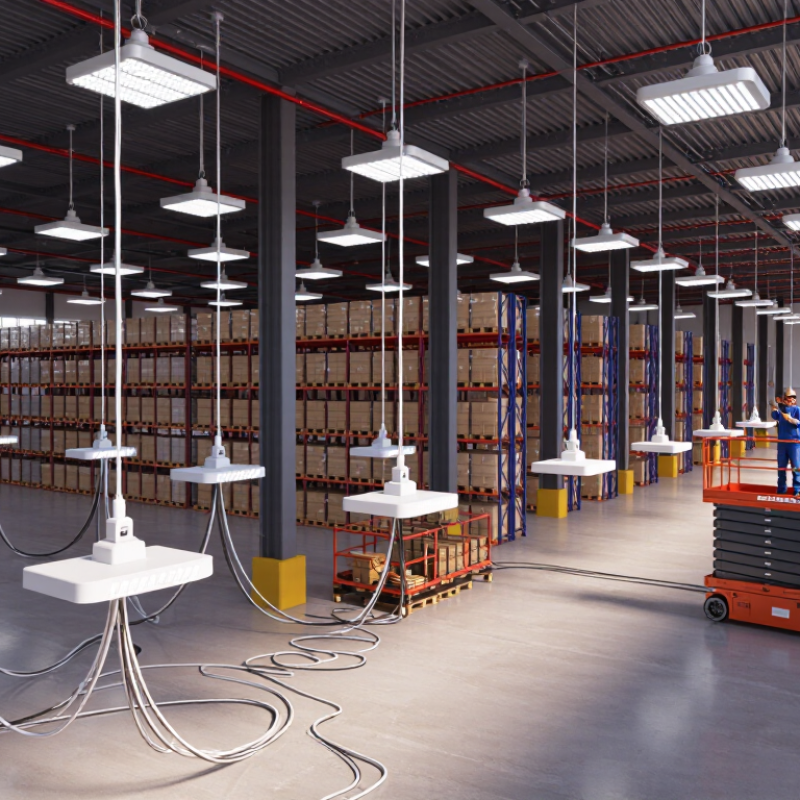
China LED high bays often serve warehouses, workshops, ports, and sports halls. Their tall mounting height makes replacement expensive and disruptive. Surge protection means adding a device that diverts brief overvoltage energy away from the LED driver. It is not a brightness feature. Lightning is only one cause. Utility switching, capacitor banks, and long cable runs can create damaging transients. IEEE C62.41.2 classifies electrical environments by exposure level, rather than treating every installation alike.
IEC 61643-11 defines performance and testing principles for low-voltage surge protective devices. It helps engineers compare clamping voltage, discharge current, and failure behavior. Practical selection still depends on the site. An outdoor 200-watt high bay under a 12-meter steel roof faces different risks from an indoor unit. Designers should check the driver’s surge rating, grounding method, and SPD status indicator. IP65 protects against dust and water, but it does not automatically stop surges. That distinction is often missed.
The IEA’s Buildings 2023 report estimates that buildings consume about 30% of global final energy. Reliable lighting supports that efficiency goal. During commissioning, electricians can record line voltage, bonding continuity, and SPD status. Photographs of panels and cable routes improve later fault analysis. Protection should be coordinated across service entrances, branch circuits, and luminaires. More protection is not always better. Poor grounding can create false confidence. Manufacturers should publish test conditions, not vague claims such as “industrial grade.” That evidence is less glamorous, but much more useful.
| Data Dimension | What It Means for an LED High Bay | Typical Risk or Requirement | Recommended Protection Approach | Practical Result |
|---|---|---|---|---|
| Electrical Supply Location | High bays installed in factories, warehouses, workshops, and sports facilities may be connected to long branch circuits or larger distribution systems. | Medium to High Long wiring can increase exposure to switching transients and externally induced surges. |
Use a suitable surge protective device (SPD) at the luminaire, lighting circuit, or distribution board, depending on the installation design. | Reduces the likelihood that transient overvoltage will damage the LED driver or control electronics. |
| Lightning Exposure | Outdoor-facing buildings, isolated warehouses, and facilities in regions with frequent thunderstorms have greater exposure to lightning-related surges. | High Nearby or direct lightning events can produce severe transient currents. |
Coordinate the luminaire SPD with the building’s grounding, bonding, and lightning protection system. A higher-capacity SPD may be required for the installation category. | Improves the system’s ability to withstand surge events, although no SPD can guarantee protection from every direct lightning strike. |
| LED Driver Sensitivity | The driver converts incoming AC power to regulated DC power for the LED array and may include sensitive semiconductor components. | High Surges can cause immediate failure or shorten the driver’s service life. |
Select a luminaire with an integrated SPD or install a coordinated external SPD with appropriate voltage, current, and discharge ratings. | Protects one of the most electrically sensitive and commonly replaceable parts of the high bay. |
| Switching Transients | Large motors, compressors, welding equipment, variable-frequency drives, and capacitor banks can create transient overvoltages when switched. | Medium to High Industrial electrical systems may generate repeated internal surges even without lightning. |
Evaluate the complete electrical installation and use coordinated SPDs at relevant distribution points. | Helps reduce repeated electrical stress and nuisance failures in industrial lighting circuits. |
| Power Grid Stability | Voltage disturbances may occur because of utility switching, faults, restoration events, or heavily loaded distribution networks. | Medium Repeated disturbances can affect driver reliability over time. |
Use an SPD designed for the nominal supply system and verify that the driver also meets the required input-voltage range. | Provides transient protection while maintaining normal operation within the specified supply limits. |
| Installation Height and Wiring Length | High bays are often mounted several meters above the floor and may use long cable runs from the distribution panel. | Medium Long conductors can increase induced surge voltage and make maintenance more difficult. |
Keep SPD connecting conductors short and properly routed. Consider protection at both the distribution board and the luminaire when the risk assessment supports it. | Improves clamping performance and helps protect equipment located far from the main panel. |
| SPD Connection Configuration | SPDs may be connected between line and neutral, line and protective earth, or in a configuration suitable for the supply system. | Critical An incorrect configuration may provide inadequate protection or create a safety hazard. |
Match the SPD to the earthing arrangement, system voltage, number of phases, and local electrical code. Installation should be performed by a qualified electrician. | Ensures the protection device operates as intended without compromising electrical safety. |
| Nominal Voltage Compatibility | The SPD’s maximum continuous operating voltage must be compatible with the actual AC supply and its permitted voltage variation. | Critical An incorrectly rated SPD may conduct during normal operation or fail to clamp effectively. |
Check the luminaire input voltage, system frequency, earthing arrangement, and SPD voltage rating before installation. | Prevents premature SPD failure and supports reliable operation of the high bay. |
| Surge Current Capacity | Surge current capacity indicates how much transient current an SPD can discharge under specified test conditions. | Application Dependent A higher capacity may be appropriate for exposed or industrial locations, but the value must match the design risk. |
Choose the discharge-current rating using a site risk assessment and the applicable installation standard rather than relying only on a larger numerical value. | Provides protection appropriate to the site without creating unnecessary cost or coordination problems. |
| Clamping Voltage | Clamping voltage is the voltage level at which the SPD limits a transient. Lower is not automatically better if normal operating conditions are not considered. | Important The SPD must limit the surge while remaining stable during normal supply voltage and temporary overvoltage conditions. |
Compare the SPD’s protection level with the withstand capability of the LED driver and the requirements of the electrical system. | Balances effective surge limitation with dependable everyday operation. |
| Protection Device Type | SPDs are commonly categorized by their intended installation location and ability to handle different surge environments. | Application Dependent The required type depends on whether the installation is at the service entrance, distribution board, or final circuit. |
Use a coordinated protection design. Service-level protection and final-circuit protection may serve different purposes and should not be treated as interchangeable. | Creates layered protection rather than relying on a single device for every surge condition. |
| Integrated Versus External SPD | An integrated SPD is built into the luminaire or driver assembly; an external SPD is installed separately and may be replaceable. | Design Choice Integrated units simplify the product installation, while external units can make maintenance and replacement easier. |
Check the product documentation for SPD status, protection mode, ratings, indicator functions, and replacement procedures. | Allows the protection method to be selected according to access, maintenance, and project requirements. |
| Grounding and Bonding Quality | An SPD needs an effective protective conductor and a low-impedance path to divert surge energy. | Critical Poor grounding, loose connections, or excessive conductor length can greatly reduce protection performance. |
Verify protective-earth continuity, bonding, conductor routing, and connection torque during installation and inspection. | Enables the SPD to discharge surge energy safely and consistently. |
| Environmental Conditions | High bays may operate in dusty, humid, hot, cold, or chemically active environments that can affect electrical connections and components. | Medium Environmental stress can accelerate insulation aging and corrosion, increasing failure risk. |
Use a luminaire enclosure and SPD suitable for the location. Confirm ingress protection, operating temperature, and maintenance requirements. | Supports longer service life for both the luminaire and its surge protection components. |
| SPD End-of-Life Indication | Many SPDs include a visual status indicator or an optional remote alarm to show when protective elements have been consumed. | Low to Medium Without an indication method, a failed SPD may remain unnoticed. |
Prefer a clear status indicator and include periodic inspection in the facility maintenance plan. | Helps maintenance personnel identify when protection needs replacement rather than discovering the issue after a lighting failure. |
| Applicable Safety Requirements | Electrical safety, luminaire construction, and surge protection requirements may be governed by national regulations and recognized international standards. | Mandatory Requirements vary according to the country, supply system, building type, and installation method. |
Review the applicable local electrical code and relevant standards for luminaires, SPDs, wiring systems, and lightning protection. Product documentation should state applicable test information. | Improves compliance, installation safety, and confidence in the stated surge-protection performance. |
Their electronic drivers respond quickly to voltage changes. Sensitive capacitors, controllers, and semiconductors may suffer damage.
It can travel through power lines, control wiring, long cables, or nearby lightning activity. Metal structures may conduct transient energy.
Yes. Motors, transformers, and switching devices can produce smaller repeated surges. They may still weaken the driver over time.
Watch for flickering, sudden shutdowns, repeated breaker trips, or failure after several storms. Burn marks may be absent.
No. The driver is often more sensitive than the LEDs themselves. Blaming the lamp may lead to the wrong repair.
An SPD redirects unwanted energy toward protective earth. This reduces stress on the driver, insulation, and control circuits.
Not always. External protection deserves consideration with long wiring, frequent storms, difficult access, or unstable electrical networks.
Verify grounding continuity, voltage rating, discharge capacity, response time, and connection length. Follow local electrical requirements.
No. A surge protector cannot correct weak grounding or loose earth connections. This detail is easy to underestimate.
Record flickering, breaker trips, storm dates, and failed fixtures. Patterns help electricians investigate instead of replacing lights blindly. I still think records are often neglected.
Understanding why do some led high bays require surge protection begins with recognizing the electrical demands of industrial lighting. LED high bays contain sensitive electronic drivers that can be damaged by sudden voltage spikes caused by lightning, utility switching, motor operation, or unstable power systems. Unlike traditional lamps, LEDs may fail partially or completely when their internal components experience excessive electrical stress, leading to unexpected downtime, reduced performance, and higher maintenance costs.
Surge protection devices help redirect excess voltage away from the LED driver and other critical components, improving fixture reliability and extending service life. The appropriate protection level depends on the installation environment, including indoor factories, warehouses, outdoor loading areas, and locations with frequent storms or heavy equipment. When selecting protection, consider surge rating, response time, grounding quality, installation position, and compatibility with the lighting system. Properly matched protection provides a practical way to safeguard China LED high bays and maintain consistent illumination in demanding industrial applications.

 Lijah Light